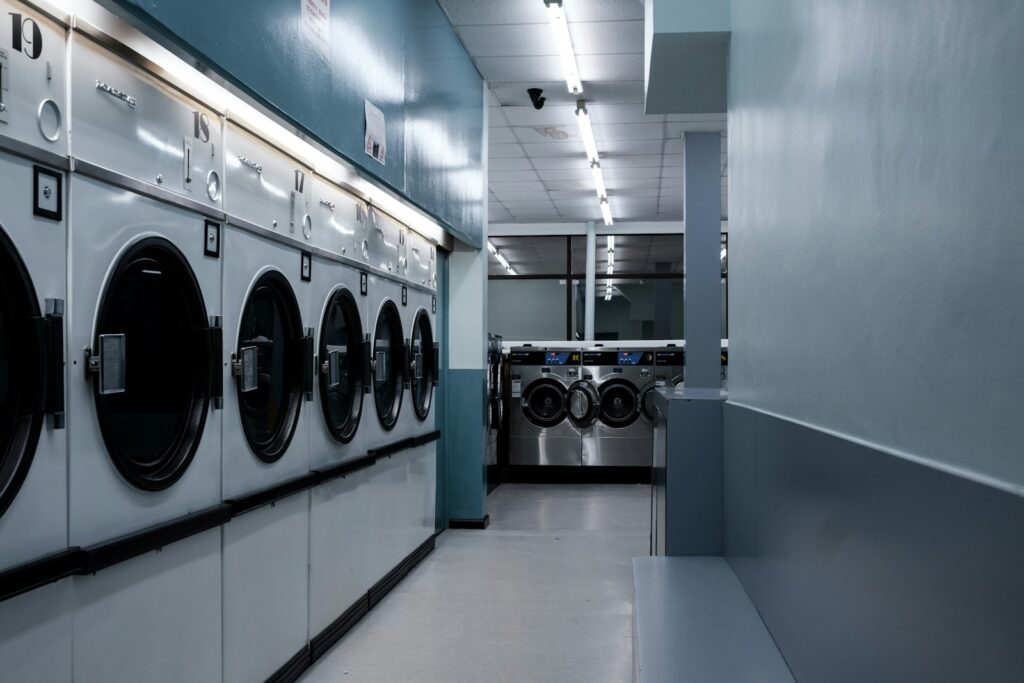
Laundromats, also known as self-service laundries, offer self-service washing machines and dryers. They are found in city centers, commercial areas, or near university campuses. They allow customers to do their laundry independently, often 24/7. Laundromats are distinguished from traditional dry cleaners by their lack of on-site staff and their fully automated operation.
This segment belongs to the laundry and dyeing branch, which encompasses all activities related to cleaning, ironing, and maintaining laundry, whether it be clothing, household linen, or professional textiles. Laundry and dyeing includes both professional services (dry cleaners, industrial laundries) and self-service options, catering to the laundry.
Do you need a market study on the self-service laundry sector? EPSIMAS can take care of it for you!
The laundry and dry cleaning market (NAF code 96.01B) in France is experiencing sustained growth. Between 2023 and 2024, the sector’s revenue surged by 8,92%. Between 2024 and 2025, growth will continue at a more moderate pace, reaching 3.56%. This growth is part of a long-term trend. Between 2016 and 2025, the sector is expected to grow at an average annual rate of approximately 3.82%, with growth accelerating since 2021. According to Epsimas’ initial estimates, this market is projected to have generated more than 891 million euros in fiscal year 2025.
In March 2026, more than 14,317 establishments were recorded in the sector. The average annual revenue for these establishments is estimated at €66,403 in 2023. However, this revenue can vary significantly from one establishment to another due to several factors, particularly location.
In terms of attendance, a laundromat welcomes an average of 20 to 50 customers per day, and the total number of cycles completed is rapidly increasing: 10 million in 2024 with a projected trend of 11 million in 2025, compared to only 4.5 million in 2020, according to the specialized brand Wash Me. This evolution is accompanied by a continuous rise in the creation of establishments registered under the NAF code 96.01B over the past ten years, confirming the sector's attractiveness and its steady expansion.

French people use laundromats an average of one to two times a week, with usage concentrated mainly on weekday evenings and during the weekend. Sunday is generally the busiest day.
The average cost per wash cycle ranges between €10 and €20, including washing and drying. This amount varies depending on the laundromat's location, the pricing of the machines, and the duration of the cycles needed.
Laundromats primarily fulfill a practical need, especially for consumers who don't own a washing machine at home. They are fully integrated into urban lifestyles, appreciated for their accessibility, speed, and the ability to handle bulky laundry. Customers prioritize efficient equipment that allows for a complete cycle in a reduced amount of time, as well as simple payment solutions, particularly contactless payment.
The user profile is very diverse. Students and young professionals represent a significant portion of the clientele, often because they live in small apartments where installing a machine is impossible. Modest households find an economical solution in this, avoiding the costs associated with purchasing and maintaining equipment.
Alongside these regular users, occasional customers come for specific needs: washing bulky laundry like duvets or blankets, dealing with excess laundry after a move or trip, or even temporary use when their personal machine is broken. We also see consumers who have machines at home but are attracted by the speed and efficiency of professional machines, which are often more powerful than domestic models.
Sources: Businesscoot, Epsimas
The market today is driven by several strong trends. Digitalization is becoming essential: laundromats are equipping themselves with connected machines capable of sending real-time notifications to smartphones: machine availability, cycle completion, estimated waiting time, or even the occupancy level of the premises. This digitalization improves the customer experience, reduces waiting times, and allows operators to better manage their machine fleets thanks to remote monitoring tools.
Payment methods are also modernizing: beyond coins, laundromats are adopting contactless payments, credit cards, and mobile apps, making them more accessible and reducing management constraints. Hygiene is becoming another central criterion, pushing operators to strengthen cleaning protocols and offer machines with antibacterial programs. The environmental aspect is gaining importance with the arrival of eco-responsible equipment, which consumes less water and energy, as well as the increasing use of more virtuous detergents. The demand for increased speed is driving the development of express washing, with shorter cycles.
In parallel, an upscale trend is being observed: some establishments are offering a more comfortable, better-appointed, and higher-quality environment to differentiate themselves. Finally, machines for bulky laundry (suitable for duvets, blankets, or thick textiles) are becoming more common and are attracting a wider clientele, including those equipped at home.
Seasonality is very pronounced. Since 2010, the peaks in revenue for sector 96.01B have been in May, June, and August. On Google Trends, we observe the same trend for the interest in “self-service laundry” in August as well as in April.
Sources: Epsimas, Global market insight, Wash Me
Laundromats primarily offer washing and drying services, sometimes supplemented by the availability of detergent, fabric softener, or specialized products. Some establishments also provide additional options, such as machines suitable for bulky items or express programs.
Geographic distribution shows a significant concentration in Île-de-France, a region where urban density and small housing sizes favor the use of carsharing. Next come the Auvergne-Rhône-Alpes and Provence-Alpes-Côte d’Azur regions, also characterized by large urban areas and a high student or tourist presence.
The market is made up of various players. First, there are large chains organized as franchises, like Wash'n Dry, which ensure a national presence and standardized services. In addition, there are brands connected to international laundry equipment groups, such as Speed Queen (Alliance Laundry Systems), which focus on the technology and performance of their machines. Finally, an important network of independent laundromats completes the offering, bringing a diversity of positioning, services, and quality depending on the neighborhoods and regions.
96.01B – Laundry and dry-cleaning services
This subclass includes:
CThis subclass does not include:
Related products:
96.01.11 – Self-service laundry services
96.01.12 – Dry-cleaning and laundry services (including fur cleaning)
96.01.13 – Ironing Services
96.01.14 – Dyeing and Coloring Services
January 15, 1996 – Home textile cleaning services
96.01.19 – Other textile cleaning services
Sources: INSEE
Don't hesitate to contact us to discuss your projects!
You can leave us your contact information via the Contact form, or book an appointment directly below.