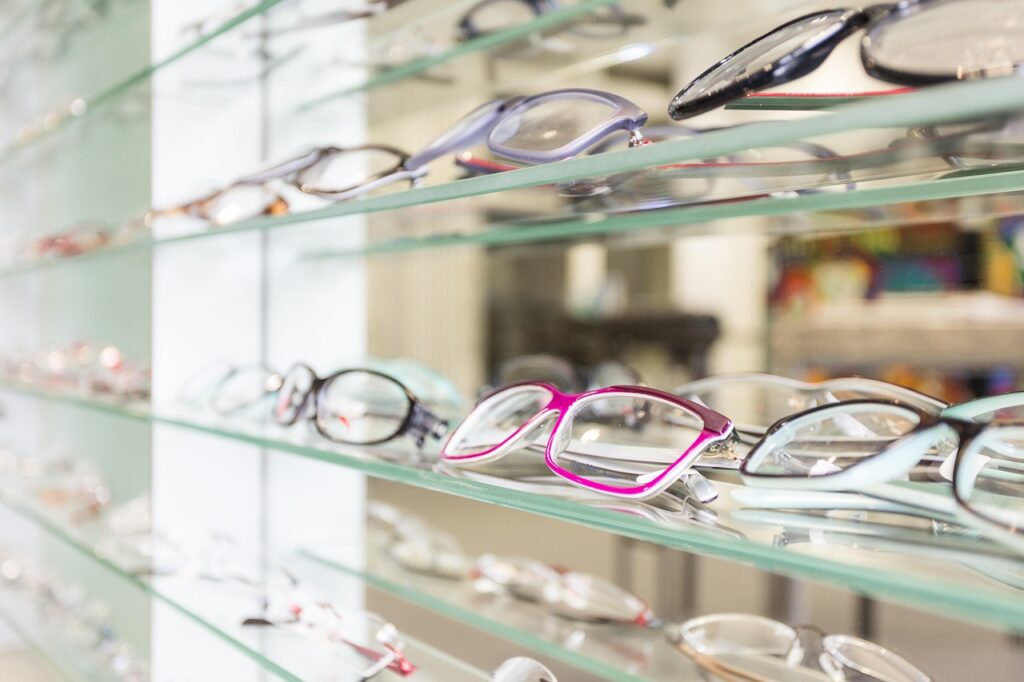
The optics market is regaining its momentum after the drop in 2020 due to the pandemic. In 2025, initial estimates place the revenue of the opticians' market at 7.3 billion euros.
The optics market (whose NAF code is 47.78A - Retail trade of optical goods) encompasses all activities related to the sale of products and services intended for the correction or protection of vision. It mainly includes the sale of prescription glasses (frames and corrective lenses), contact lenses, sunglasses, as well as maintenance products and accessories. In addition to this commercial function, opticians also play the role of healthcare professionals by performing eye exams and ensuring the proper fitting of optical equipment.
Nevertheless, the sector is becoming increasingly competitive. Major retail chains are multiplying. Online platforms are gaining ground. The optician's role is thus tending to reinvent itself, placing service and advice at the heart of the profession. The number of qualified opticians continues to grow. There were 27,000 in 2014, and there are more than 44,000 in 2025. That represents a density of 65 opticians per 100,000 inhabitants.
Do you need market research on the opticians sector? EPSIMAS takes care of it for you!
The optical market is growing steadily each year. In 2025, revenue is estimated at 7.3 billion euros, according to preliminary estimates from EPSIMAS. This market thus grew at an average annual rate of 4.18% between 2016 and 2025. Ua growth partly explained by the strong demand linked to vision disorders, affecting a large majority of the population.
In France, more than 7 out of 10, among those over 20 years old, wear glasses or contact lenses. Vision disorders are thus the most frequent sensory impairments in France. 75% for adults over 20 years of age are affected, and up to 97% of those over 60. If left untreated, these conditions can become debilitating in daily life. Among people over 80, 24 % have difficulty reading a newspaper, even with glasses, and 17% can no longer recognize a face from four meters away. LWomen are more numerous to report visual problems, particularly for distance vision. Social disparities are also observed regarding vision disorders. Indeed, manual laborers and office workers, who are less inclined to consult, more often live with uncorrected disorders.

The supply on the French optical market is structured around four main segments: prescription lenses, optical frames, sunglasses, and contact lenses, with a wide variety of ranges and prices.
Prescription eyeglasses account for the largest share of the product lineup (approximately 65 % of revenue), followed by frames (25 %) and contact lenses, which, together with related products, account for approximately 10 % of the market. Sunglasses, although less central, round out the product offering, particularly during the summer months. The introduction of the 100 % Health basket has also altered the product mix by expanding access to optical equipment, encouraging retailers to offer both standardized «reimbursable» products and more premium lines.
Sources: Businesscoot, GfK
The French tend to remain loyal to their optician. In 2024, 72% buy their glasses at the same store as last time, which is 3 points higher than in 2023. This behavior can be explained by a very high level of satisfaction: 94% of customers say they are satisfied.
The frequency of replacement, meanwhile, is declining. Only 32% of French people have replaced their prescription glasses in the last 12 months, compared to 34 % in 2023. On average, a consumer replaces their glasses every 2.5 years. However, 66 % took advantage of their in-store visits to purchase other products, such as sunglasses or contact lenses. Upselling is therefore an effective driver of revenue growth in this sector.
This slowdown in eyewear replacement can also be attributed to a lack of information. Only 52 % of French people know that they can renew their glasses directly at the optician’s, without having to see an ophthalmologist again. It should be noted, however, that the average French consumer does not feel a strong need to renew their glasses. 90% of spectacle wearers are willing to keep their glasses if only the prescription changes. This tendency is particularly strong among those over 65 (95%), compared with 81% among 18- to 24-year-olds. These choices have a direct impact on the market. Sales of frames are declining: –3.21% quarter-over-quarter in 2023, following –4.11% quarter-over-quarter in 2022. Conversely, sales of lenses are rising: +1.2% in 2023, +4.2% in 2022.
Expectations are also changing when it comes to the environment. 80 % of French people say they support the local refurbishment of their old items, particularly their eyeglasses.
Sources: Arcane Research ; INSEE, Acuity, Drees
Innovation and comfort: The optics market is evolving rapidly. Lenses now integrate advanced technologies: progressive lenses, blue-light blocking, hydrophobic, anti-smudge, or even photochromic. Frames and lenses adapt to each customer's needs through innovation in materials and design. Contact lenses follow the same dynamic. Soft or rigid (gas-permeable) models offer more comfort and address accommodation problems.
Digitization Digital technology is also transforming the sector. Smart glasses and augmented reality are entering the market. These connected devices make daily life easier by interacting with other devices or applications. They pave the way for a convergence between optics, health, education, and entertainment.
Sustainability and responsibility: Another key trend: eyewear is becoming more responsible. Manufacturers are adopting sustainable practices and incorporating eco-friendly materials into their production. Frame refurbishment is also very popular with a segment of consumers.
Online sales and e-commerce: Finally, e-commerce is emerging as a major sales channel. Online purchases are increasing sharply, particularly among young people. The latter use tools like virtual try-on via webcam to choose their equipment remotely.
The opticians' market is experiencing sustained growth, driven by strong demographic, technological, and societal trends. This evolution is explained by several factors. On the one hand, the aging of the population naturally increases the need for vision correction. On the other hand, the increase in vision disorders among younger people is notably linked to prolonged and early exposure to screens. Finally, there is a growing appeal for technological innovations in the field of visual health.
The market offers numerous opportunities: augmented reality, visual prevention and screening, sports eyewear, blue-light blocking devices, and the personalization of lenses and frames. Optics is thus positioning itself as a future-proof sector, driven by innovation and research.
At the same time, consumer demand is undergoing a profound shift. Customers are no longer content with simple vision correction; they now expect a comprehensive solution that combines health, comfort, aesthetics, and practicality, tailored to every stage of life. Digital technology is transforming habits and expectations, with the emergence of new products and distribution channels. In this context, opticians are being led to rethink their role and their offering to stay in step with these new aspirations.
Don't hesitate to contact us to discuss your projects!
You can leave us your contact information via the Contact form, or book an appointment directly below.