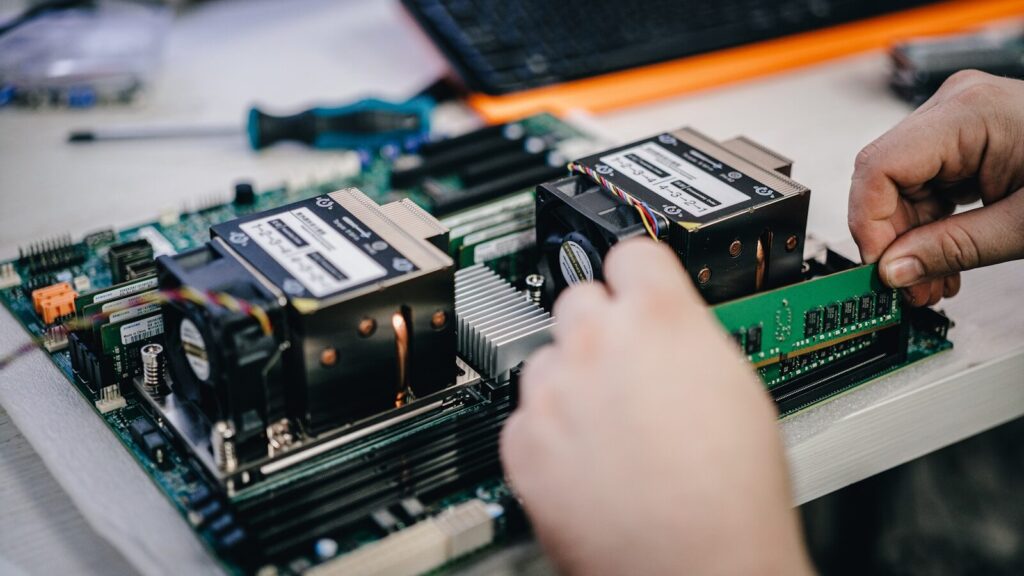
The computer repair market (NAF code 95.11Z) includes all technical services for diagnosing, maintaining hardware, and troubleshooting software for IT equipment. This activity, which has become strategic with the widespread adoption of remote work, is defined by its ability to extend the lifespan of devices in the face of obsolescence and unexpected breakdowns. For the modern user, a computer is no longer a mere accessory but a vital work tool whose downtime directly impacts productivity.
The sector is currently organized around a diverse ecosystem where several business models coexist. On one hand, official manufacturer networks and authorized centers maintain control over warranty repairs and access to original parts. On the other hand, a dense network of independent technicians and local shops provides everyday service for individuals. This landscape is complemented by national franchises that standardize the offering, as well as by industrial players in refurbishment that structure a secondary market for used parts. In this context, providers' success no longer relies solely on technical expertise, but on a critical balance between responsiveness of service and transparency of costs.
Need a market study on computer repair? EPSIMAS can take care of it for you!
The computer repair market (NAF code 95.11Z) is showing mixed trends in 2025. According to preliminary estimates from EPSIMAS, this market generates revenue of 4.3 billion euros. The sector experienced a decline between 2008 and 2013, before gradually rebounding. Despite a slight decline in 2025 (-0.91%), revenue from computer repairs continues to grow modestly each year. Between 2016 and 2025, the market is expected to grow at an average annual rate of 1.27%.
The computer repair industry will have 14,948 active businesses in 2026, including 11,154 sole proprietorships. In this sector, the three-year survival rate is 50.5%, meaning that nearly one in two businesses closes its doors after three years. Margins in the sector tend to be limited, with an average EBITDA margin of 7.14% and a profitability margin of 2.67%.

Today, three main categories of individuals seek compensation:
The Eco-conscious This consumer is environmentally conscious. Driven by the AGEC law, they monitor the durability index of appliances. They want to reduce their carbon footprint. They prioritize parts with traceable origins and check their electronic waste management. For them, repair is more important than buying new.
The constrained budget: This profile is subject to the rising prices of new equipment. Repair is an economic necessity for them. They seek to keep their work tool performing well without investing significant sums. Their choice is based on the cost-effectiveness of the intervention.
The senior profile: This category prioritizes continuity and emotional security. The computer often stores a lifetime of memories. These users fear data loss and the complexity of a new interface. They seek an expert to maintain a familiar software environment and secure their personal files.
Today, consumer expectations are focused on two points: cost and responsiveness. With the rise of remote work, computers have become an indispensable tool, making repair times more critical than ever.
Sources: Epsimas
The computer repair market in 2026 is organized around various players whose roles are strictly segmented. Between 2016 and 2025, the number of new computer repair businesses opened kept pace with the sector’s revenue growth, reaching an average annual growth rate of 1.85%. In the last twelve months alone, the sector has seen 1,666 new businesses open. These businesses are primarily located in major economic hubs: Île-de-France, Auvergne-Rhône-Alpes, Occitanie, and Nouvelle-Aquitaine.
The computer repair market comprises official manufacturer networks and authorized centers. Companies like Apple or Wefix hold exclusivity on repairs under warranty. They control access to proprietary original parts, which limits third-party intervention on recent models.
At the same time, the sector of independent contractors and local shops forms the densest territorial network. These technicians perform the majority of hardware and software troubleshooting for individuals and very small businesses.
The mid-range segment is occupied by national franchises, such as LDLC. These brands industrialize repair processes. They offer standardized services and extended warranties in the second-hand market, thus reassuring hesitant customers.
Finally, an industrial refurbishment sector completes the ecosystem. Platforms like Back Market collect massive flows of end-of-life equipment. They dismantle, repair, or recycle machines on a large scale. These players create a structured secondary market that fuels the resale of used goods and the stock of second-hand spare parts.
The IT support sector is undergoing a profound transformation due to new technologies. Remote troubleshooting represents a major innovation. This process allows the specialist to access a remote system via the internet to resolve software issues in real time. This method eliminates the need for the professional's physical presence. It generates time and cost savings for all parties.
AI is emerging as a significant ally. It facilitates the automation of diagnostics and radically improves the performance of technical services by predicting failures before they occur. For example, for a Mac user, AI recommends the ideal specialist based on the exact nature of the encountered issue.
Eco-responsibility is becoming a decisive choice criterion. Repairers favor recyclable and energy-efficient components. This approach reduces energy waste and promotes sustainable technology use. For example, a wise choice of professional equipment increases its lifespan and reduces its overall carbon footprint.
Cloud computing is also transforming traditional approaches. This system, based on remote servers, promotes data flexibility and security. It offers an optimal solution for regular backups. However, this technology requires increased vigilance in cybersecurity. Faced with an alarming rise in attacks, repair technicians are becoming protection experts. Security is no longer a luxury, but an essential component of troubleshooting.
Google Trends searches for «computer repair» reveal significant seasonality. A major peak occurs during the back-to-school period in September. A second rebound is observed in January. Activity slows considerably in July and August. The rapid succession of peaks and troughs reflects the constant urgency of technical needs and a more or less sustained level of activity throughout the year.
Source : Google Trends, Bioinformatics
Electronics repair can be registered under different NAF codes depending on the company's activity:
Subclass 95.11Z: Repair of computers and peripheral equipment
This subclass includes
the repair and maintenance of:
This subclass does not include
repair and maintenance of modems, carrier equipment (cf. 95.12Z)
95.12Z Repair of communication equipment
This subclass includes
the repair and maintenance of communication equipment, such as:
UnderClass 95.21Z: Repair of consumer electronics
This subclass includes
Repair and maintenance of consumer electronics
Source : INSEE
Don't hesitate to contact us to discuss your projects!
You can leave us your contact information via the Contact form, or book an appointment directly below.